S&P500 Daily Action Areas & Price Targets 22/10/26

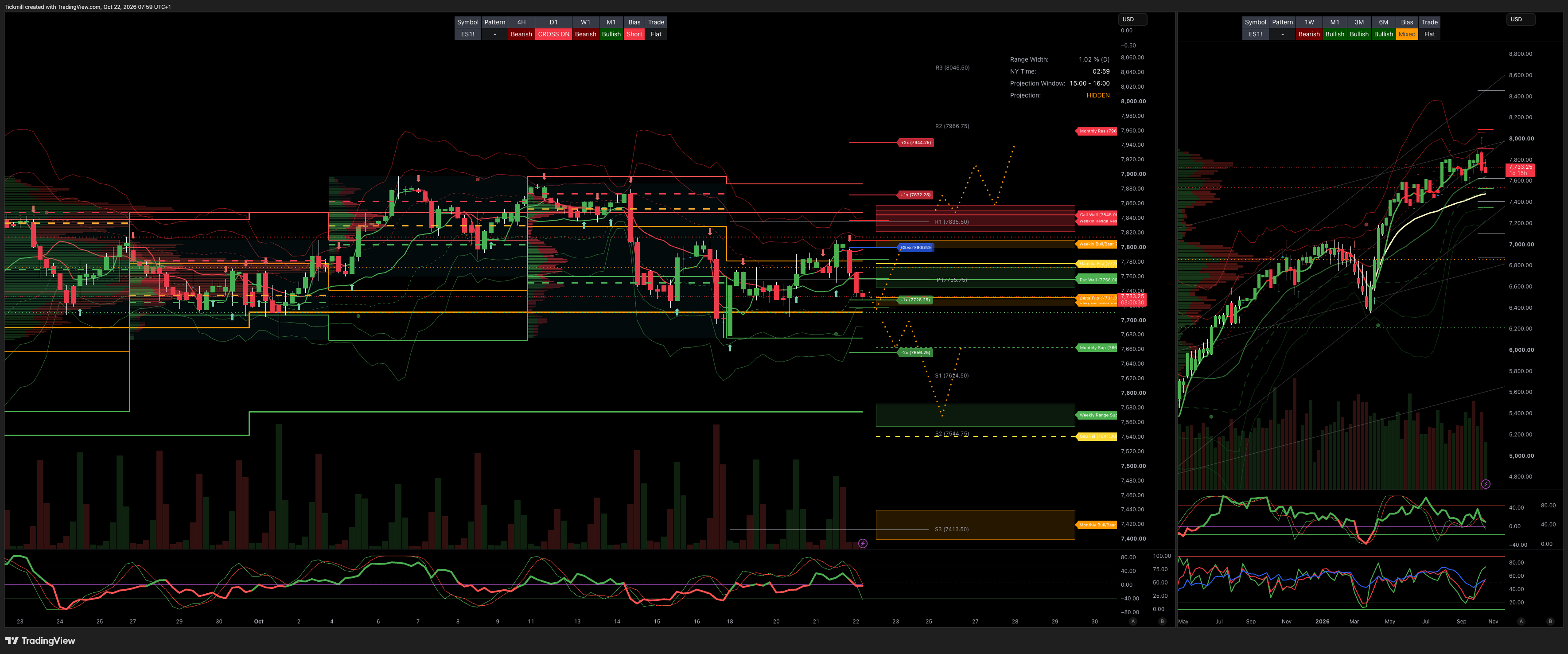
S&P500 Daily Action Areas & Price Targets 22/10/26
***QUOTING ES1!(Z CONTRACT LEVLES) FOR CASH US500 EQUIVALENT LEVELS, SUBTRACT POINT DIFFERENCE***
MONTHLY-WEEKLY& DAILY LEVELS
MONTHLY BULL BEAR ZONE 7440/7400
MONTHLY RANGE RES 7960 SUP 7663
WEEKLY BULL BEAR ZONE 7800/10
WEEKLY RANGE RES 7851/22 SUP 7555/86
DAILY BULL BEAR ZONE 7730/20
GLOBEX RANGE SUP 7773/45 RES 7830/58
GAMMA FLIP 7778
DELTA FLIP 7731
CALL WALLS 7845
PUT WALLS 7756
DAILY STRUCTURE - OTFH - 7751
WEEKLY STRUCTURE - BALANCE - 7897/7575
MONTHLY STRUCTURE - OTFH - 7542
VIX BULL BEAR ZONE 17.7
VVIX-to-VIX The ratio of 5.8 compression is the main market driver, with the VVIX dropping more than the VIX, maintaining the ratio within the 5.0 to 6.0 range. This indicates a decrease in short-term tail risk insurance premiums, favoring volatility-selling strategies. Above 6.0 – 7.0+ signals higher risk and demand for options due to market volatility concerns.
PRIMARY TRADES & TARGETS
LONG ON RJECT/RECLAIM DBBZ TARGET WBBZ > ACCEPTANCE ABOVE WBBZ TARGET DAILY RANGE RES
***ADDITIONAL SETUPS & TARGETS HIGHLIGHTED ON THE CHARTS***
(I FADE TESTS OF 2 SIGMA LEVELS ESPECIALLY INTO THE FINAL HOUR OF THE NY CASH SESSION AS 90% OF THE TIME WHEN TESTED THE MARKET WILL CLOSE ABOVE OR BELOW THESE LEVELS)
SPX PUT/CALL RATIO 1.17 (The numbers reflect options traded during the current session.) A put-call ratio below 0.7 is generally considered bullish, and a put-call ratio above 1.0 is generally considered bearish.
JHEQX Upside cap (~7,920–7,950): Dealer gamma hedging at this call strike creates resistance, with market makers likely selling futures into strength and limiting volatility. Downside cushion (~7,270): If SPX drops 5% into Q4, long put gamma may force dealers to buy futures as the index falls, helping stabilize prices. Expiration: December 31, 2026. Strong pinning effects are likely near key strikes into year-end expiration.
DEC2025 OPEX to DEC2026 OPEX is 945 points giving us a range of [5889,7779]
Notes On Structure Implications
Balance: This refers to a market condition where prices move within a defined range, reflecting uncertainty as participants await further market-generated information. Our approach to balance includes favouring fade trades at the range extremes (highs/lows) while preparing for potential breakout scenarios if the balance shifts.
One-Time Framing Higher (OTFH): This represents a market trend where each successive bar forms a higher low, signalling a strong and consistent upward movement.
One-Time Framing Lower (OTFL): This describes a market trend where each successive bar forms a lower high, indicating a pronounced and steady downward movement.
GOLDMAN SACHS FICC & EQUITY TRADING DESK VIEWS
THE TAKE: MOMENTUM RERATING & MEGAPRINT BEATS TRIGGER ACCELERATED RIGHT-TAIL CHASE
US equities closed firmly higher across major benchmarks (S&P 500 +58 bps to 7,757.17; Nasdaq-100 +113 bps to 29,822; Russell 2000 +36 bps to 2,783), driven by aggressive momentum buying and tactical chasing across high-velocity growth pockets. The rally pulled the S&P 500 to within ~0.79% of its October 6 record high (7,818.93). While Mag7 mega-caps lagged intraday due to rotation into SpaceX (SPCX), GOOGL channel checks, and funding reallocation ahead of upcoming tech primary debt issuance, broader market participation was robust with WTI Crude pulling back -1.80% to $101.79/bbl.
After the closing bell, the Q3 earnings catalyst wave delivered significant fundamental beats across mega-cap tech and growth anchors:
Meta Platforms (
META+5% AH): Delivered a strong Q3 revenue beat and issued robust Q4 revenue guidance of $73B–$76B (nicely above $73.57B consensus). Announced a new class of shares planned for January 2027.Tesla (
TSLA+4% AH): Bounced on qualitative commentary that turned distinctly more positive regarding 2027 vehicle platform ramps and full self-driving (FSD) monetization, following solid Q3 delivery figures earlier in the month.IBM (
IBM+6% AH): Surged post-market as software revenue growth accelerated to +9% YoY constant currency (vs. +5% in Q2), fueled by a sharp rebound in Transaction Processing.Lam Research (
LRCX-7.5% AH): Plunged despite beating quarterly metrics and guiding Q2 gross margins to 52.4% (slightly above street consensus), reflecting high whisper expectations across semicap equipment.
MARKET SUMMARY & ASSET BREAKDOWN
S&P 500 (SPX): Closed at 7,757.17 (+0.58%) | MOC $400M to BUY | VIX down -3.52% to 16.70 | Remaining weekly straddle: 78 bps
Nasdaq-100 (NDX): Closed at 29,822.00 (+1.13%) | Outperformed broader market on growth re-risking and tech short covers
Russell 2000 (RUT): Closed at 2,783.00 (+0.36%) | Small-caps maintained positive trajectory
Dow Jones (DJI): Closed at 52,857.00 (+0.69%) | Industrial heavyweights supported the advance
US 10-Year Treasury: Yield unch at 5.120% | Yields stabilized near cycle highs
WTI Crude: Price down -1.80% to $101.79/bbl | Eased back from recent geopolitical peaks
Gold: Price up +0.25% to $4,135.00/oz | Consolidated as USD Index held firm (DXY 101.69)
Bitcoin: Price up +2.10% to $84,485.00 | Strong risk-on crypto bid
INSTITUTIONAL FLOWS & DESK POSITIONING
Execution Floor Activity (5/10 Rating):
Execution floor finished +3% better to buy on relatively muted gross notionals.
Asset Managers (LOs): Finished roughly flat. Selective demand appeared in Financials, REITs, Industrials, and Energy, offset by supply in Utilities, Healthcare, and Tech.
Hedge Funds (HFs): Finished as small net buyers, driven by demand in Tech, Healthcare, and Financials vs. supply in Communication Services.
Semiconductor Flow Dynamics:
Semicaps and broader chips experienced a tactical bounce (SMCI +10% on positive preliminary updates) after declining in 10 of the prior 11 sessions. However, desk flows noted that buying conviction remains underwhelming, with fundamental accounts reluctant to step in aggressively ahead of full sector earnings clearance.
DERIVATIVES & VOLATILITY SURFACE COLOR
Volatility Term Structure & Fixed-Strike Bidding: Following Wednesday morning's VIX futures expiration, index volatility caught a firm bid across the entire term structure. Notably, fixed-strike volatility was bid directly on the topside chase—a dynamic absent from options markets during recent weeks.
Options Skew Compression: Options skew experienced continuous compression throughout the session as spot stabilized and moved higher.
Sizable Short-Dated Upside Buying: Flow desk observed institutional buyers stepping in to purchase short-dated right-tail call options in massive size:
$18M in total premium spent split across SPY Nov 800 Calls and SPY Dec 810 Calls.
Tactical Vol Strategy Call: With institutional positioning remaining highly defensive (GS Sentiment Indicator at -1.3 SD; US L/S net leverage near 5-year lows) and the S&P 500 sitting just 1.1% off its October 6 peak, the vol desk identifies right-tail upside hedges as exceptionally cheap.
Featured Trade Structure: SPY Nov 800/815 Call Spreads, offering an asymmetric 8x max payout ratio to capture a potential post-earnings / post-election upside breakout.
Disclaimer: The material provided is for information purposes only and should not be considered as investment advice. The views, information, or opinions expressed in the text belong solely to the author, and not to the author’s employer, organization, committee or other group or individual or company.
Past performance is not indicative of future results.
High Risk Warning: CFDs are complex instruments and come with a high risk of losing money rapidly due to leverage. 68% and 74% of retail investor accounts lose money when trading CFDs with Tickmill UK Ltd and Tickmill Europe Ltd respectively. You should consider whether you understand how CFDs work and whether you can afford to take the high risk of losing your money.
Futures and Options: Trading futures and options on margin carries a high degree of risk and may result in losses exceeding your initial investment. These products are not suitable for all investors. Ensure you fully understand the risks and take appropriate care to manage your risk.
Patrick has been involved in the financial markets for well over a decade as a self-educated professional trader and money manager. Flitting between the roles of market commentator, analyst and mentor, Patrick has improved the technical skills and psychological stance of literally hundreds of traders – coaching them to become savvy market operators!